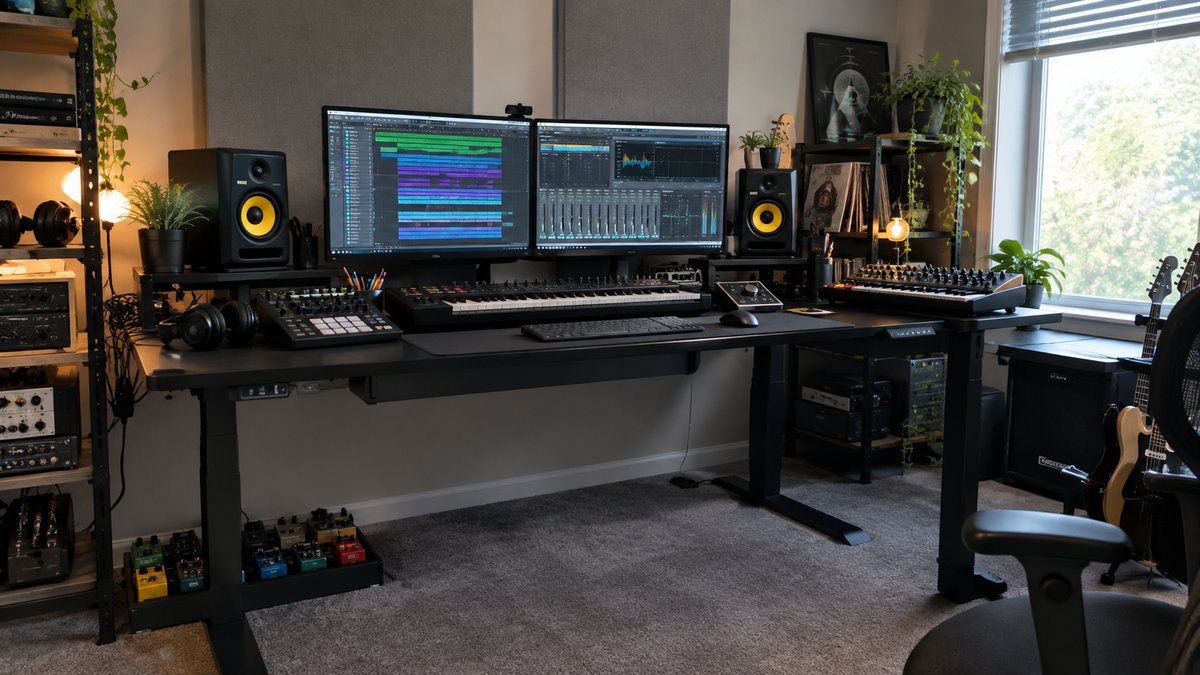
Music production loads a sit-stand desk differently from office work. Studio monitors, a MIDI controller, an audio interface, and sometimes a synth or drum machine add weight and, more importantly, they are sensitive to movement and noise. This guide plans a music production standing desk setup around real studio gear, using the CreatorOne and CyberOne Modular ranges as the reference frames.
1. List the Studio Gear First
Write down everything that has to sit on the desk before you size anything:
- Studio monitors (near-field). The heavy, placement-critical items.
- MIDI controller or keyboard. Wide and shallow, it eats front-edge depth.
- Audio interface and a USB hub for tracks and plugins.
- Possible synth, drum machine, or pad controller on the side.
- One or two screens for the DAW and video reference.
Add the real weights. A pair of 5–8″ monitors plus a controller and interface often lands 50–80 lb before cables and stands. Compare the complete supported load with the dynamic rating of the exact desk configuration, including any desktop and accessory allowances specified by the manufacturer.
2. Weight and Stability: Why a Wobble Ruins a Mix
In music production, stability is part of accuracy. A desk that moves when you lean or when the kick hits changes what you hear: the monitor shifts, the stereo image blurs, and your gain decisions drift. CreatorOne rates the Main frame at 315 lb dynamic (630 lb static); CyberOne Modular has dynamic load ratings of 300–475 lb, depending on the layout. Pick the frame whose rating clears your real gear, and check that it holds steady at full height.
- CreatorOne Main: dynamic 315 lb (static 630 lb).
- CyberOne Modular: dynamic load of 300 lb (Main), 365 lb (L-shape), or 475 lb (Extended L / U-shape).
The two numbers are different rating types. Do not compare them head to head. Match each to your loaded desk weight.

3. Depth and Layout for Controllers + Monitors
Depth sets whether the controller and monitors share one row. A standard Main top on the CreatorOne range runs about 31.5″ deep, enough for a controller at the front and monitors behind it. If you want the monitors on stands with isolation pads in their own lane, step up to an L-shape with 63″ of return width.
Monitor placement rule: keep each near-field tweeter at ear level and aimed at your head, forming an equilateral triangle with your listening position. That triangle is why desk height matters. Raise the desk and the monitors go up with it.

4. Height: Mixing Sitting, Producing Standing
Most producers mix seated and produce or jam standing, so both ends of travel count. The CreatorOne range moves 30.3–47.2″; CyberOne Modular moves 30.3–44.9″. Measure your seated and standing working positions and confirm that both fall within the selected desk’s usable height range.
The catch: when you raise the desk, the monitors rise too. Either re-check your triangle at the new height or accept a slightly different listening angle for standing sessions. Plan your presets around one seated mix height and one standing work height so you are not re-aiming monitors every time.
5. Cable Routing That Stays Hum-Free
Audio is unforgiving about cabling. Route it once, before gear goes down:
- Keep balanced XLR/TRS audio cables away from AC power and wall-wart transformers to avoid ground hum.
- Run monitor and interface feeds down the leg channel or an under-desk tray, not draped across the floor.
- On CyberOne Modular, the multi-port charging station ($89) consolidates phone, tablet, and accessory power into one drop instead of several wall warts near your audio path.
6. Modules That Help Long Sessions
Studio time runs long, and that is where the CyberOne smart modules earn a place:
- Multi-port charging station: $89. One hub for phone, tablet, reader.
- Hot/cold cup coaster: $99. Keeps water warm through a late mixing session without leaving the chair.
- RGB ambient light: $79. Requires the metal pegboard ($149) first; mood lighting, not a monitoring tool.
7. Two-Zone Option for Producing + Mixing
If producing and mixing are separate modes for you, an L-shape gives two zones on one frame: the long side holds the controller, keyboard, and screens; the return holds the monitors and interface in a fixed listening spot. You raise and lower the whole thing together, so your mix position stays consistent while your production mode goes upright.
FAQ
Can you produce music at a standing desk?
Yes. Many producers sit for critical mixing and stand for playing and arranging. A desk with a low seated minimum (around 30″) and a standing maximum near 47″ covers both, as long as you re-check monitor height at each preset.
How deep should a desk be for music production?
About 30″ deep fits a controller plus monitors in one row. If you want monitors on stands in their own lane with the controller behind, move to an L-shape with a 63″ return.
How much weight can a standing desk hold for studio gear?
Monitors plus a controller and interface often land 50–80 lb. CreatorOne rates the Main frame at 315 lb dynamic; CyberOne Modular has dynamic load ratings of 300–475 lb, depending on the layout. Compare dynamic ratings with dynamic ratings for the selected layouts, and account for the complete supported load.
Ready to build the studio desk?
Compare the CreatorOne frames and the CyberOne Modular configurator, and see the full module list in the accessories collection.
Keep reading:
What Makes a Standing Desk Stable? 4 Things That Matter
Standing Desk Depth Guide for Monitor Arms and Creator Setups